Confrontation Between Box Men at the Hospital
The Box ManThe Confrontation Between Box Men at the Hospital turns a contest over identity and evidence into a physical struggle. The Box Man Narrator has a photograph that can expose the man inside the other box as a doctor, but the Doctor answers the threat by aiming an air rifle at the narrator’s left eye. Their struggle makes the objects surrounding them—film, rifle, box, and an unlikely toy crocodile—tools of both concealment and revelation.
Causes and Stakes
Before the fight, the narrator describes the photograph he took when he was hit: it shows a man climbing a sloping road with a rifle concealed along his body. The man’s haircut, made-to-order suit, conspicuously wrinkled trousers, and low shoes lead the narrator to identify him as a doctor making house calls. The road was beside a soy factory. These details give the narrator a case to make, but not a film he can immediately produce: when asked to show it, he says he has not brought it and treats it as his only guarantee of an equal right to speak.
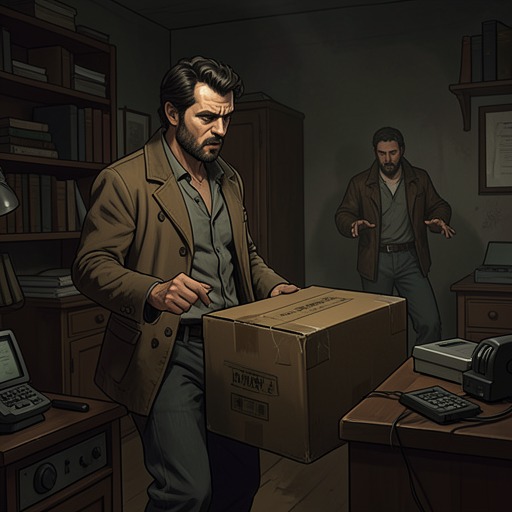
The man he is trying to expose is initially motionless inside his box, which stands upright like a harmless rubbish bin. Then the box shakes, its vinyl observation curtain parts, and a long stick emerges: an air rifle aimed directly at the narrator’s eye. The weapon abruptly changes the exchange from an argument about proof into a threat of bodily injury. The Doctor urges the nurse to search the narrator, apparently hoping to seize or disarm him and secure the evidence.
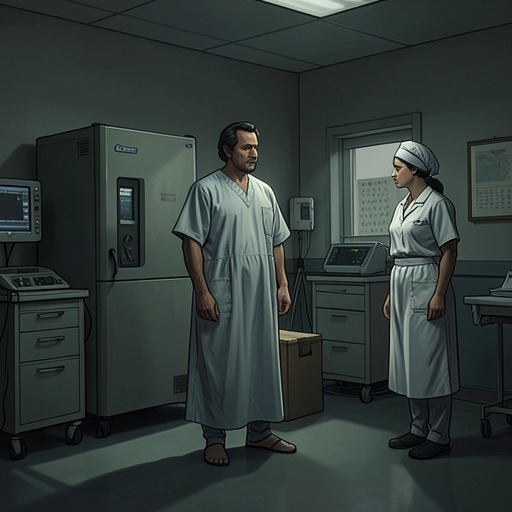
The nurse hesitates and looks to the narrator. As she leans forward, her white tunic falls open; only its top button is fastened, and she is naked underneath. The narrator is surprised, though he had partly anticipated her nakedness, and interprets the garment as making her appear more exposed than nakedness alone would. Her movement narrows his field of vision and makes him feel aggressive, a reaction he says he does not understand. The moment also leaves the nurse’s position uncertain: her hesitation could signal discomfort with the Doctor’s authority, but it does not settle whether she is the narrator’s ally.
The Fight
Rather than let the nurse search him, the narrator retrieves his belongings from a box near the door and opens a mountain-climbing bag, probably surplus from the American Army. From it he takes a stuffed crocodile. The toy is less than eighteen inches long, with a sixteen-and-a-half-inch girth, green paint, plastic eyes and fangs, a warty back, light-brown claws, and a red mouth. Its childlike appearance conceals its actual purpose: the narrator has removed its usual filling and, that morning, packed its skin with beach sand to make a blackjack.
The narrator explains the weapon’s practical advantage as well as its disguise. A blow can be fatal without leaving an external wound; afterwards, the sand can be emptied and scattered in a garden, leaving no obvious indication that a toy crocodile served as a weapon. Here, the familiar plaything is not simply a disarming object. Its harmless appearance hides a capacity for violence, just as the box conceals the Doctor and his identity.
Pretending to offer the crocodile to the false Box Man, the narrator strikes upward against the rifle barrel. The blow knocks the barrel into the upper frame of the observation window, and the box jumps. The rifle discharges toward the ceiling; the narrator hears air escape, but no sound of the bullet striking. He wrests the gun away. The Doctor reaches through the window and grabs the narrator’s right cheek, squeezing it like rice cake. The narrator responds with a heavy blow to the Doctor’s farther shin. The Doctor shrieks and pulls his arm back inside the box.
The narrator then strikes at the top of the box, but stops because he does not want to damage it. Instead he continues hitting the shin, taking care not to break bones in a way that might allow the Doctor to remain in the hospital. The Doctor curls into a ball and becomes passive; his groans make him seem less like the commanding figure behind the rifle than a man hidden inside a container. In the pale ten o’clock light, the narrator sees the box against the white mortar wall as a scooped-out hole. The fight has reversed the apparent balance of power, but it has not destroyed the structure that conceals the Doctor.
The Unsettled Aftermath
The narrator turns from the box to the nurse and treats her response as the next test. He speculates that visible relief would mean she had been estranged from the Doctor and that the narrator had freed her from his restraint. Fear of accepting the narrator, by contrast, might mean that she and the Doctor had been accomplices, leaving the narrator in danger. He even considers whether the buttons of her tunic will be fastened, then rejects that detail as an unreliable measure of her attitude. The scene closes on uncertainty rather than a confirmed alliance or a completed escape.
That uncertainty is intensified by the narrator’s awareness of the account as a written construction. He questions whether he is the person continuing the notes and acknowledges the contradiction in time identified by the false Box Man. He imagines the next scene as one whose outcome will reveal what he gained or lost by leaving his own box. The fight therefore ends physically—with the Doctor driven back into his container—but remains unresolved as a question of narration, intimacy, and trust.
The Doctor’s Account and the Conflict’s Background
A later affidavit supplies the professional history that gives the confrontation its wider stakes. Its writer identifies the corpse being discussed as the Army Medical Captain whose name and identity he borrowed in order to practise medicine. He explains that, during the war, he served as an orderly under that doctor and took on much of the examination and treatment of patients while the doctor pursued research into making sugar from wood. Under the doctor’s guidance, he learned to perform complicated operations.
The writer says he continued administering drugs to the doctor, who became addicted, and remained with him after demobilization. They opened a clinic together, but the doctor’s illness left him unable to examine and treat patients; the writer carried out the work. The affidavit presents several reasons for continuing the illegal practice: friendship and the perceived difficulty of treating the Doctor’s addiction, a livelihood protected by the borrowed qualifications, growing patient trust, and the writer’s increasing interest and confidence in medicine. He claims twelve years of experience and diligent study, while acknowledging that skill and good intentions did not make practising without a licence lawful.
The account also complicates the conflict’s personal history. The writer says he was still legally unmarried but had lived with Nana, the Doctor’s legal wife, with the Doctor’s approval; Nana managed the accounts and helped as a nurse. Their household changed after he hired Toyama Yoko as an apprentice nurse, and Nana proposed that they live apart. The Doctor, meanwhile, opposed the writer’s withdrawal from medical work, threatened suicide, and used pressure to keep him from leaving. The affidavit thus casts the box-and-rifle confrontation against a longer struggle involving dependency, professional authority, borrowed identity, and control over other people. It does not turn the physical victory into a simple resolution: the narrator has taken the weapon, but the Doctor’s box, the nurse’s uncertain allegiance, and the narrator’s own unsettled account all remain.